
Nutrient Density vs Calories: Why Eating Smarter Matters More Than Eating Less
Julia BloszykNutrient Density vs Calories: Why Eating Smarter Matters More Than Eating Less
For years, nutrition has been framed around calories.
Eat fewer.
Burn more.
Track everything.
But as you get older, many people notice something frustrating:
You can eat the same number of calories as you did ten years ago… and feel worse.
More tired.
Less satisfied.
Hungrier between meals.
That’s because calories are only part of the story.
The more useful question is:
Nutrient density vs calories — what are those calories actually made of?
Quick take: Nutrient density measures nutrients per calorie. As calorie needs often decrease with age, nutrient-dense foods can support steadier energy, satiety, and recovery.
Nutrient Density vs Calories: What’s the Difference?
Calories are a measure of energy.
Nutrient density describes how many vitamins, minerals, fibre, and beneficial plant compounds a food contains relative to its calorie content.
In other words: how much nutrition you get per bite.
What Is Nutrient Density? (With a Simple Example)
Consider two 400-calorie choices:
- 400 calories of pastries and refined carbohydrates provide energy, but minimal micronutrients.
- 400 calories of vegetables, legumes, quality protein, and healthy fats provide fibre, antioxidants, minerals, and amino acids alongside energy.
Both provide calories.
Only one meaningfully supports resilience.

Why Nutrient Density Matters More After 40
In your 20s and 30s, your body is often more forgiving. You can compensate for nutritional gaps with energy reserves, more stable hormones, and faster recovery.
After 40, several subtle shifts occur:
- Muscle mass gradually declines without resistance training
- Metabolic flexibility reduces slightly
- Recovery slows
- Hormonal changes can affect appetite and fat distribution
At the same time, calorie needs may decrease slightly due to changes in muscle mass and activity levels.
Here’s the key:
Your calorie requirement may fall — but your nutrient requirement does not.
In many cases, it becomes even more important.
The Hidden Problem: Energy Without Nourishment
Many modern diets are energy-rich but nutrient-poor.
Ultra-processed foods are designed to be convenient and hyper-palatable. They provide calories efficiently — sometimes too efficiently — without delivering the micronutrients your body relies on for:
- Energy metabolism
- Nervous system regulation
- Muscle repair
- Immune function
- Inflammation balance
This creates a paradox:
You’re consuming enough — even too many — calories,
but still not feeling properly nourished.
Common signs include:
- Afternoon crashes
- Strong cravings
- Slower recovery
- Increased abdominal fat storage
- Persistent low-grade fatigue
Not because you lack discipline — but because your physiology is under-supported.

Why You Can Feel Tired Even When You Eat Enough
Your cells don’t just need fuel.
They also need the tools to convert that fuel into usable energy.
That process depends on micronutrients like:
- B vitamins
- Magnesium
- Iron
- Zinc
- Phytonutrients
- Amino acids
Without enough of these, energy production can become less efficient — which is why you can feel tired even when calorie intake is “fine”.
This is why nutrient-dense foods affect how you feel, not just how you look.
How to Eat More Nutrient-Dense (Without Eating Less)
This isn’t about restriction. It’s about upgrading quality.
✔ Build meals around protein
Supports muscle maintenance and satiety.
✔ Prioritise colourful plants daily
Different colours = different phytonutrients.
✔ Increase fibre gradually
Supports gut health and steadier blood sugar.
✔ Reduce “empty calories”
Not by banning foods — but by reducing reliance on them.
✔ Focus on consistency, not perfection
Small improvements compound.
Where Greens Fit In
In an ideal world, every meal would include vegetables, broad plant diversity, and mineral-rich foods.
In reality, busy weeks narrow dietary variety.
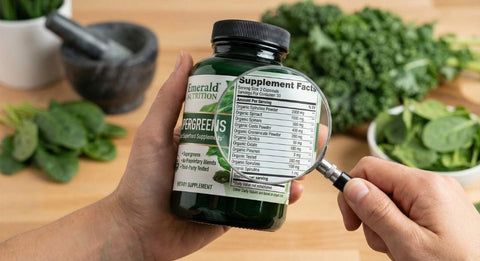
 A well-formulated greens supplement can help support baseline micronutrient intake and provide concentrated plant nutrients — particularly during periods when fresh produce intake is inconsistent.
It isn’t a replacement for whole foods.
It’s a practical reinforcement of nutrient density — helping to close gaps without increasing overall calorie intake.
If you’re short on plant variety during busy weeks, Emerald Nutrition Supergreens can be a simple addition alongside a food-first diet. Buy Emerald Nutrition Supergreens
The Bigger Reframe
Sustainable health is rarely about eating less.
It’s about eating more strategically:
More:
- Protein
- Fibre
- Minerals
- Plant diversity
- Whole foods
And less reliance on calorie-dense, nutrient-poor convenience.
When nutrient density improves, many people notice:
- Steadier energy
- Fewer cravings
- Better recovery
- More natural body composition shifts
Not because you forced it — but because your body is better supported.
The goal isn’t to obsess over numbers.
It’s to ensure the energy you consume genuinely nourishes you.
That’s eating smarter — and over the next 20–30 years, that approach compounds far more powerfully than calorie counting ever will.
FAQs: Nutrient Density, Calories, and Feeling Better
Q: Does nutrient density matter more than calories?
For long-term health, energy, and appetite control, nutrient density is often more predictive of how you feel day to day than calories alone.
Q: What are examples of nutrient-dense foods?
Vegetables, legumes, berries, eggs, fish, lean meats, Greek yogurt, nuts, seeds, and whole grains—especially when minimally processed.
Q: Why do I feel tired even when I eat enough?
If micronutrients are low, your body can struggle to convert food into usable energy efficiently, which can feel like fatigue even with adequate calories.
Q: Can a greens supplement replace vegetables?
No. It can help support nutrient intake when diet variety is low, but it’s best viewed as a complement to whole foods.